
Processing your request...
Customers today use digital channels to discover businesses, compare products and services, read reviews, watch videos, and make purchasing decisions. Because of this change in customer behaviour, digital marketing has become an important part of modern business communication.
But what exactly is digital marketing?
Digital marketing refers to promoting a business, product, service, or brand through digital channels. These channels can include search engines, websites, social media platforms, email, online advertising, video platforms, content platforms, and mobile applications.
Digital marketing is not limited to posting on social media or running advertisements. It involves understanding an audience, researching their needs, creating useful content, selecting appropriate channels, measuring results, and continuously improving marketing activities.
Digital marketing is the process of using digital platforms and technologies to communicate with potential and existing customers.
Common digital marketing channels include:
One important characteristic of digital marketing is measurability. Marketers can analyse website visits, search visibility, advertising clicks, engagement, enquiries, and conversions to understand how their marketing activities are performing.
However, collecting data alone does not make a strategy successful. Marketers need to understand what the data means and use it to make informed decisions.
People use different digital platforms at different stages of their decision-making process.
For example, a person may discover a business through social media, search Google for more information, visit the website, read reviews, and then contact the business.
Digital marketing helps businesses participate in these different stages.
Digital platforms provide different ways to reach specific groups of people.
Marketers may consider:
Understanding the audience helps marketers select channels and create content that is relevant to the people they want to reach.
Consistent and useful online content can help people become familiar with a business or subject.
Blogs, videos, social media posts, educational guides, and informative website pages can all contribute to online visibility.
The objective should not simply be to appear on as many platforms as possible. The focus should be on providing useful information in places where the intended audience is actually looking.
Digital channels can also support lead generation.
Examples include:
The effectiveness of these activities depends on how well the marketing channel, message, audience, and conversion process work together.
Digital marketing allows marketers to track different performance indicators.
These may include:
These metrics can help identify which activities are performing well and which areas require improvement.
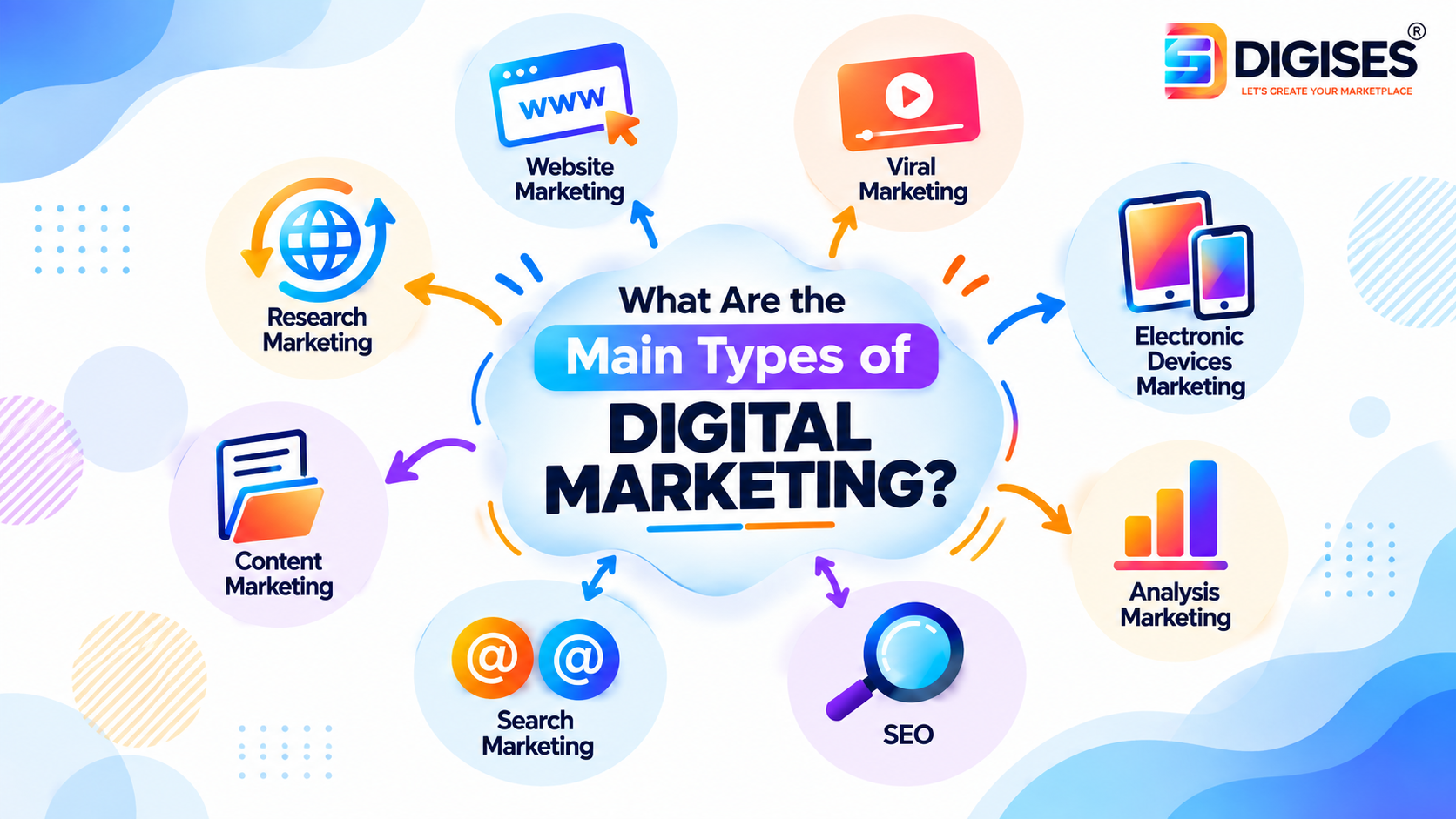
Digital marketing consists of several channels. Each channel has a different purpose, and the right combination depends on the audience, industry, objectives, resources, and customer journey.
SEO focuses on improving a website's visibility in organic search results.
SEO can involve:
Effective SEO is not simply about placing keywords repeatedly on a webpage. The content should address the user's search intent and provide useful information.
Search engine marketing can involve paid advertisements that appear for relevant searches.
Paid search allows marketers to target people who are actively looking for particular products, services, or information.
Successful paid search campaigns require attention to:
Paid advertising can provide visibility quickly, but performance depends on how effectively the campaign is planned and managed.
Social media marketing uses platforms such as Instagram, Facebook, LinkedIn, and other relevant networks to communicate with audiences.
Social media can support:
The most appropriate platform depends on where the target audience spends time and what the business is trying to achieve.
Content marketing involves creating and distributing useful information for a specific audience.
Examples include:
Good content should answer genuine questions, explain topics clearly, and help readers make informed decisions.
Email marketing allows businesses to communicate with people who have opted to receive emails.
It can be used for:
Email marketing generally works better when communication is relevant and useful rather than excessive.
Local SEO focuses on improving visibility for searches connected to a particular geographic area.
Activities can include:
Local SEO can be useful for businesses that serve customers within a particular city, region, or service area.
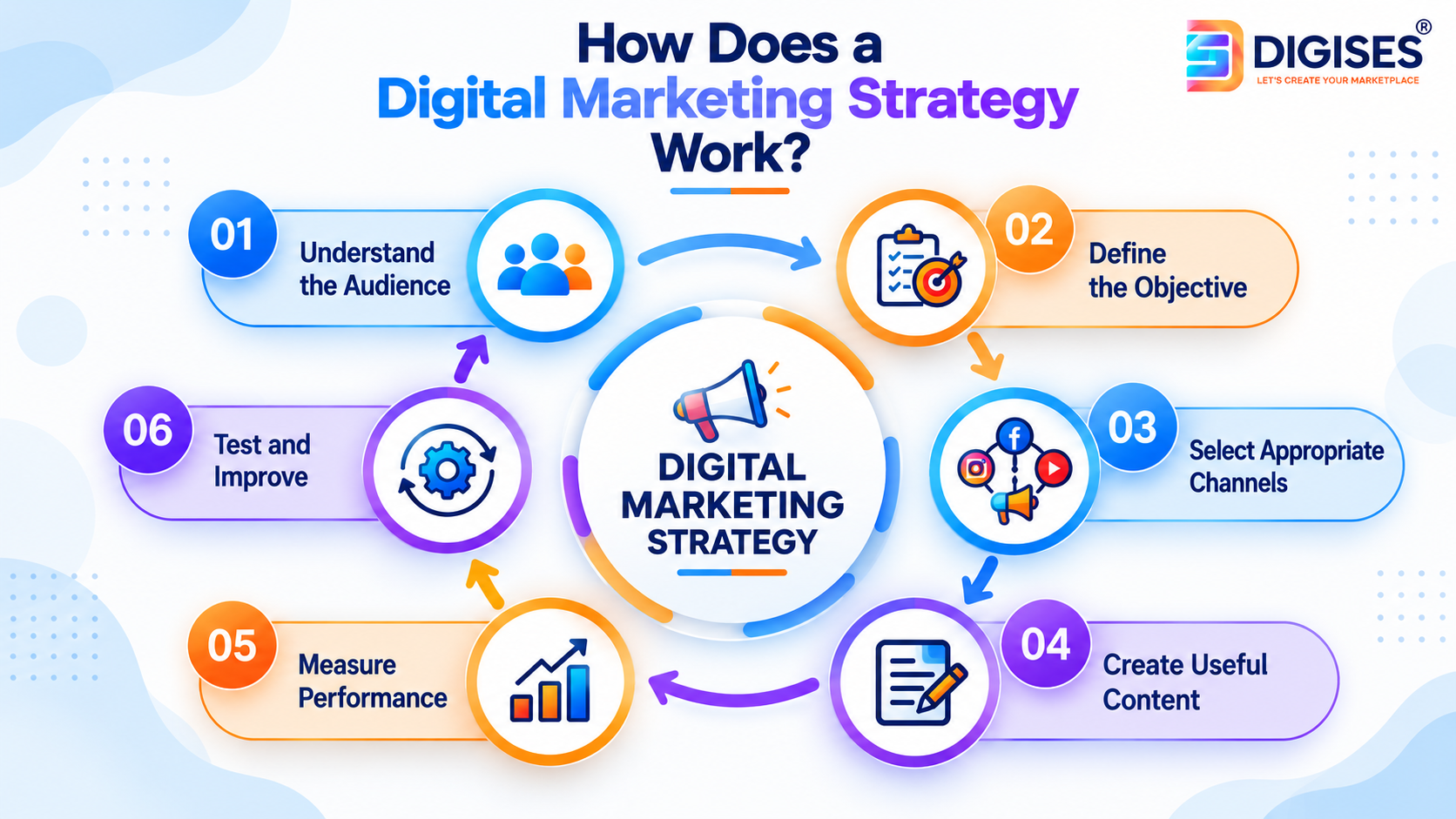
Digital marketing usually involves several connected steps rather than one isolated activity.
Marketers first need to understand who they are trying to reach.
This includes identifying their needs, problems, interests, search behaviour, and decision-making process.
The objective should be clear before selecting a marketing channel.
Depending on the situation, the objective could be:
Not every business needs every digital marketing channel.
The selection should depend on where the target audience is active and which channels are most suitable for achieving the objective.
Content should be created according to the audience's questions, needs, and search intent.
Useful content can help establish credibility and make it easier for people to understand a product, service, or topic.
Once marketing activities are implemented, marketers should monitor relevant metrics.
The measurements should relate to the original objective rather than focusing only on surface-level numbers.
Digital marketing is an ongoing process.
Marketers can analyse performance, identify problems, test different approaches, and make improvements based on evidence.
Digital marketing requires a combination of technical, analytical, creative, and communication skills.
Marketers need to communicate ideas clearly through written, visual, and verbal content.
Research helps marketers understand audiences, competitors, industries, keywords, and customer behaviour.
Data analysis allows marketers to identify patterns, understand performance, and find areas that need improvement.
Writing, visual communication, storytelling, and content planning are useful across multiple digital marketing channels.
A basic understanding of search intent, keywords, on-page optimization, technical SEO, and local SEO provides a strong foundation.
Paid advertising requires knowledge of targeting, budgets, creative testing, landing pages, and conversion tracking.
Digital platforms, algorithms, advertising systems, and customer behaviour can change over time. Digital marketers therefore need to keep learning, testing, and adapting their methods.
Several mistakes can reduce the effectiveness of digital marketing.
A large follower count does not automatically mean that a marketing strategy is successful. Engagement, relevance, leads, conversions, and business objectives also matter.
Adding keywords without answering what users actually want can result in weak content.
Businesses do not necessarily need to be active on every platform. Using fewer relevant channels effectively can be more useful than spreading resources across many platforms.
Marketing decisions should be supported by relevant performance data whenever possible.
SEO and content marketing can take time to develop organic visibility. Results vary depending on competition, website quality, content, industry, and other factors.
Digital marketing performance depends on many variables. Responsible marketing decisions should be based on realistic expectations, measurable objectives, and evidence.
Digital marketing provides several career paths for beginners.
A fresher can explore areas such as:
Beginners can develop their skills by learning the fundamentals, practising with projects, analysing campaign data, and gradually developing expertise in specific areas.
A combination of practical experience and continuous learning can help build a stronger understanding of how digital marketing works.
Digital marketing is the process of promoting a business, product, service, or brand through digital channels such as search engines, websites, social media, email, online advertising, and video platforms.
The main types of digital marketing include SEO, search engine marketing, social media marketing, content marketing, email marketing, local SEO, affiliate marketing, and mobile or video marketing.
Digital marketing works by identifying a target audience, selecting suitable digital channels, creating relevant content or campaigns, reaching users, measuring results, and optimizing activities based on performance data.
Digital marketing is important because it helps businesses reach relevant audiences online, communicate with customers, generate enquiries, build visibility, and measure marketing performance.
SEO, or Search Engine Optimization, is the process of improving a website and its content to increase its visibility in organic search engine results for relevant searches.
SEO focuses on improving organic search visibility without paying for each click, while paid advertising uses advertising platforms to display paid placements and typically charges based on campaign activity such as clicks or impressions.
The time required to see results varies depending on the marketing channel, competition, industry, budget, website quality, and objective. Paid advertising can provide faster visibility, while SEO and content marketing often require more time.
Important digital marketing skills include communication, research, content creation, SEO, analytical thinking, advertising knowledge, data interpretation, and continuous learning.
Digital marketing can be measured using metrics such as website traffic, leads, click-through rate, conversion rate, engagement, search visibility, advertising costs, and customer acquisition cost.
Yes. Digital marketing offers career opportunities in areas such as SEO, content writing, social media marketing, paid advertising, email marketing, analytics, and digital strategy.
Digises is a leading digital marketing and web development agency helping startups, SMEs, and businesses grow online. Our team shares practical insights on SEO, Google Ads, social media marketing.