
Processing your request...
Marketing is an important part of every business. Businesses use marketing to introduce their products or services, understand customers, communicate value, build awareness, and support sales.
Customers today have many choices. Before making a purchase, they may search online, compare products, read reviews, ask for recommendations, visit a store, or interact with a brand on social media.
Because of this, businesses need to understand what customers want and communicate with them in a clear and useful way.
But what exactly is marketing?
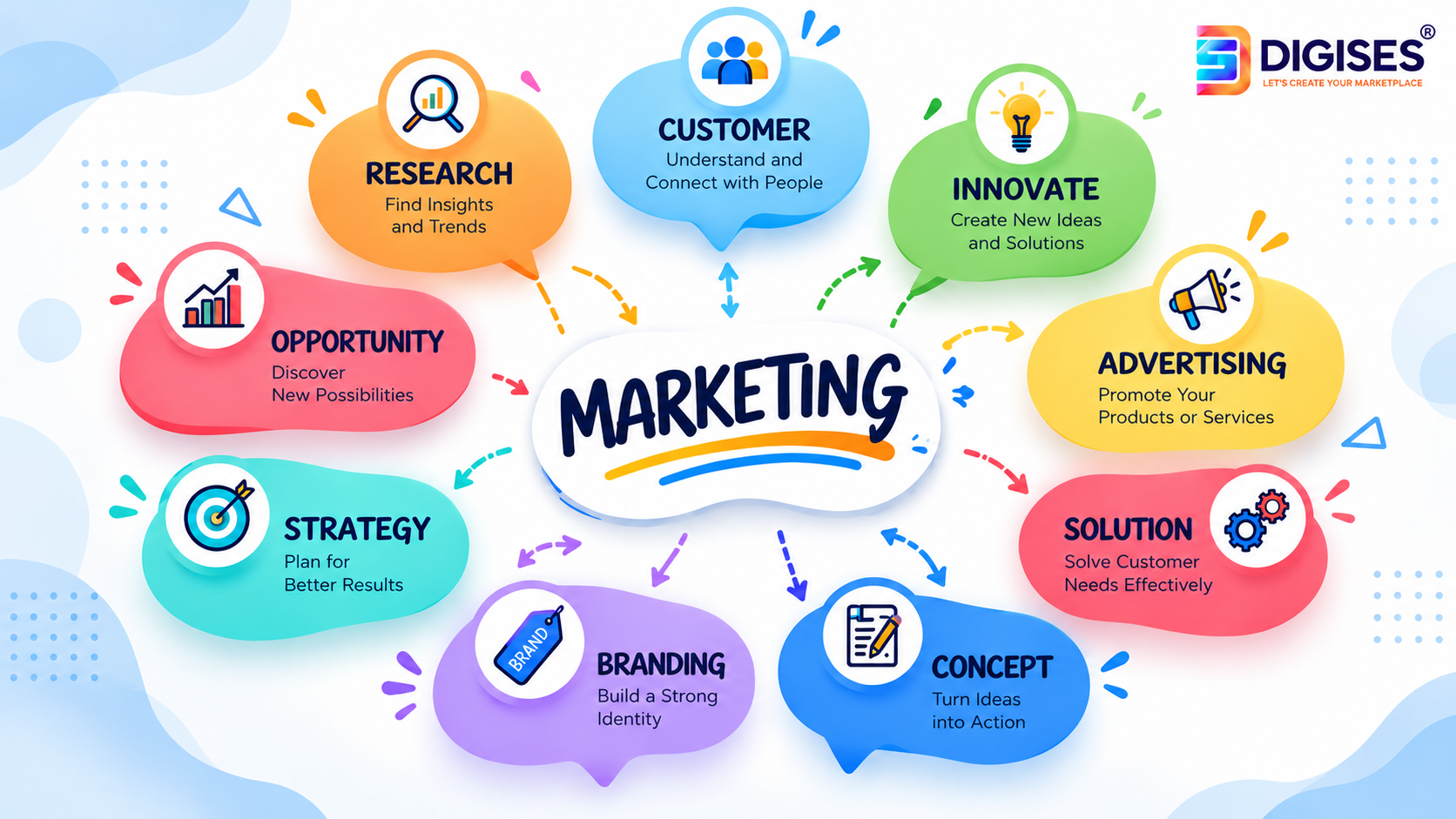
Marketing is the process of understanding customer needs, creating value, communicating that value, and making products or services available to the right audience.
Marketing is not simply advertising or selling a product.
It can involve:
The main purpose of marketing is to connect a business with people who may need or be interested in its products or services.
For example, a company selling fitness equipment needs to understand who its potential customers are, what type of equipment they need, how much they are willing to spend, and where they look for information.
Marketing helps the company understand these factors and communicate its offering effectively.
Marketing helps businesses understand their customers and communicate with them.
A good product alone does not always guarantee business success. Customers need to know that the product exists, understand its benefits, trust the business, and have enough information to make a decision.
Marketing can help businesses with several important areas.
Marketing begins with understanding the customer.
Businesses may research:
This information helps businesses create products, services, messages, and experiences that are more relevant to their target audience.
People cannot consider a product if they do not know it exists.
Marketing helps businesses create awareness through different channels such as:
The objective is not simply to appear everywhere. Businesses need to reach the right audience through channels that are relevant to their customers.
Marketing can help people become familiar with a business.
Consistent communication, useful content, clear messaging, and positive customer experiences can contribute to brand recognition.
Over time, customers may begin to associate a business with a particular product, service, quality, or value.
Marketing and sales are connected, but they are not the same.
Marketing can create awareness, attract potential customers, educate them, and generate interest. Sales activities can then help convert qualified prospects into customers.
A strong marketing strategy can therefore support the sales process by bringing relevant people into the customer journey.
Marketing does not stop after a customer makes a purchase.
Businesses can continue communicating with customers through:
Building relationships can help businesses understand customers better and encourage repeat business.
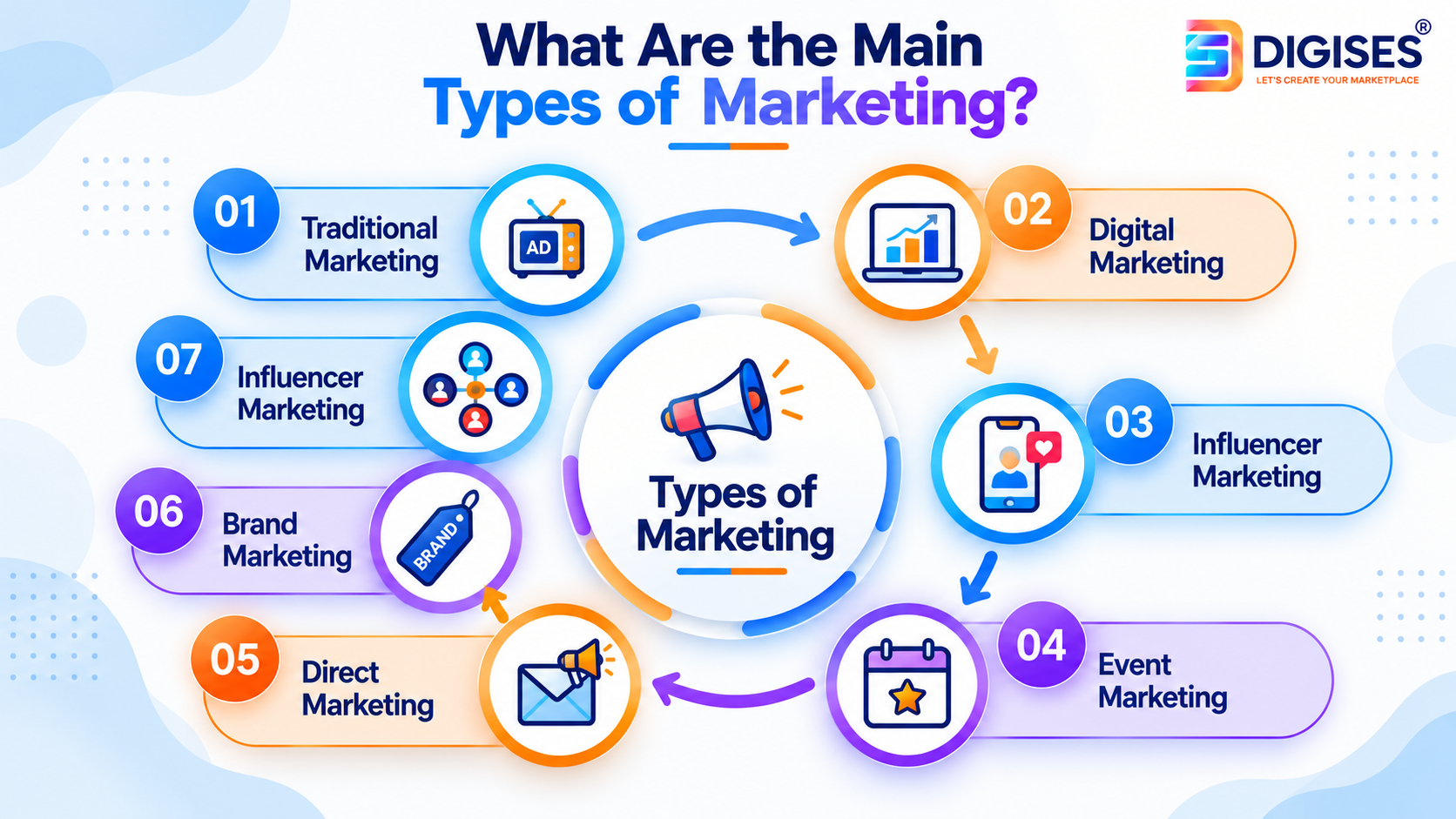
Marketing includes many different activities and channels.
The most suitable approach depends on the business, target audience, industry, budget, location, product, and marketing objective.
Traditional marketing uses offline methods to promote products and services. It helps businesses reach people through newspapers, television, radio, magazines, banners, posters, and billboards.
Digital marketing promotes products and services through online platforms. It includes SEO, social media marketing, Google Ads, email marketing, content marketing, and website marketing.
Influencer marketing uses popular content creators or influencers to promote products and services. Businesses collaborate with influencers to reach their followers, build trust, and increase brand awareness.
Event marketing promotes a brand, product, or service through events. It includes product launches, exhibitions, trade shows, workshops, conferences, and promotional events. It helps businesses connect directly with their target audience.
Direct marketing involves communicating directly with potential customers to promote products or services. It includes SMS campaigns, emails, phone calls, WhatsApp messages, and direct mail. It helps businesses share offers and encourage customers to take action.
Brand marketing focuses on building a strong brand identity and reputation. It uses brand messaging, logos, storytelling, advertising, and customer experiences to help people recognize, trust, and remember a business.
Influencer marketing involves working with individuals who have an audience or influence within a particular subject or community.
Businesses may collaborate with influencers to introduce products or services to relevant audiences.
The effectiveness of influencer marketing depends on factors such as audience relevance, trust, content quality, and the suitability of the partnership.
Marketing has evolved over thousands of years. It started with simple trading and developed into modern digital marketing. Businesses have always used marketing to attract customers, promote products, and increase sales.
In ancient times, people exchanged goods and services through a system called barter. Traders used marketplaces, word-of-mouth communication, and personal selling to reach customers.
The invention of the printing press helped businesses promote products through printed materials. Newspapers, posters, flyers, and magazines became important marketing tools.
During this period, radio and television became popular advertising platforms. Businesses could reach large audiences and promote their products to people across different regions.
Businesses began focusing more on customer needs, market research, branding, and customer satisfaction. Companies developed marketing strategies to understand their target audiences and stand out from competitors.
The growth of the internet changed how businesses reached customers. Websites, email marketing, search engines, and early online advertising became important marketing tools.
Social media platforms such as Facebook, Instagram, YouTube, and Twitter helped businesses connect directly with customers. Content marketing, influencer marketing, and targeted advertising became increasingly popular.
Modern marketing uses artificial intelligence (AI), automation, customer data, and analytics to improve campaigns. Businesses use AI tools, personalized advertising, short-form videos, and conversational marketing to reach the right audience.
Marketing requires a combination of creative, analytical, communication, and strategic skills.
Marketers need to explain ideas clearly through written, visual, and verbal communication.
Research helps marketers understand customers, competitors, industries, trends, and market conditions.
Data analysis helps marketers understand performance and identify areas that need improvement.
Content skills are useful for creating blogs, videos, social media posts, advertisements, emails, and educational materials.
Marketers need to understand customer problems, needs, motivations, and decision-making behaviour.
Marketing professionals need to connect marketing activities with business objectives.
Modern marketing often requires knowledge of digital platforms, analytics, SEO, social media, advertising platforms, and content management systems.
Marketing continues to change as customer behaviour, technology, platforms, and communication channels develop.
Continuous learning is therefore an important part of becoming an effective marketer.
A marketing funnel represents the different stages a potential customer may move through before and after making a purchase.
The person becomes aware of a business, product, service, or problem.
The person begins looking for more information.
The person compares different options and evaluates possible solutions.
The person takes a desired action, such as making a purchase or submitting an enquiry.
The business continues communicating with the customer and works to maintain the relationship.
The customer journey is not always linear. People may move between stages, return to earlier stages, or use multiple channels before making a decision.
Digises is a leading digital marketing and web development agency helping startups, SMEs, and businesses grow online. Our team shares practical insights on SEO, Google Ads, social media marketing.
No: 775/1, T H Road, New Washermenpet,
Chennai - 600081
Digises is a performance-based digital marketing company in Chennai with 50+ successful brands, helping businesses generate qualified leads, improve visibility, and achieve measurable growth.