
Processing your request...
SEO stands for Search Engine Optimization. It is the process of improving a website so that search engines can better understand its content and users can find it when they search for relevant information, products, or services. What Is SEO? A Complete Guide to Search Engine Optimization
SEO (Search Engine Optimization) is the process of improving a website and its content so that search engines can understand, discover, and index its pages, while helping users find useful information for their searches.
For businesses, SEO can improve organic search visibility, attract relevant visitors, support enquiries and sales, and build a sustainable online presence. For students and freshers, learning SEO provides a foundation for understanding how search engines, websites, content, and user behaviour work together.
SEO is not simply about adding keywords to webpages or trying to achieve higher rankings. Effective SEO involves understanding what people are searching for, creating helpful and original content, improving website accessibility and technical performance, demonstrating relevant expertise, and making the overall page useful to visitors.
SEO is a collection of practices that help websites become more understandable and useful to both search engines and people.
When someone searches on Google, search systems evaluate available content and determine which results may be relevant and useful for that particular query. SEO helps a website clearly communicate what its pages are about and makes it easier for search engines to discover, crawl, understand, and index its content.
For example, imagine a Chennai business that provides interior design services. Potential customers may search for:
Each search represents a different user need or search intent.
For example, “Interior designers in Chennai” may indicate that someone is looking for service providers, while “Interior design cost in Chennai” may indicate that someone is researching pricing before making a decision.
A useful SEO strategy considers these differences and creates content that directly addresses the questions, information, products, or services users are looking for.
Keywords remain useful for understanding the language people use when searching, but modern SEO should not be treated as a keyword-placement exercise.
A strong SEO approach considers:
Repeating a keyword unnecessarily can make content difficult to read. The better approach is to use relevant terminology naturally while providing complete and useful information.
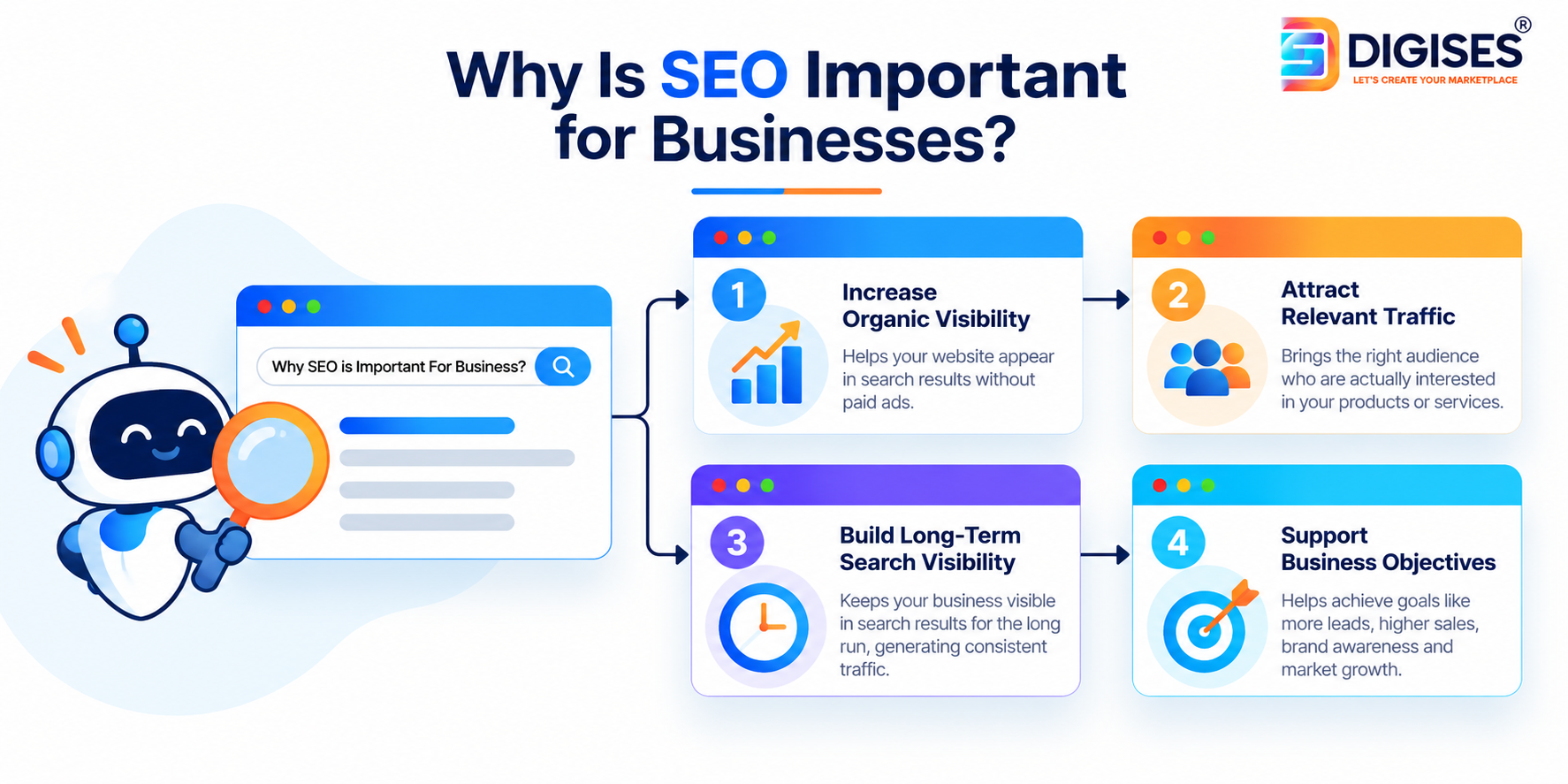
Search engines can influence how people discover businesses, research products, compare services, and make decisions.
SEO can help relevant webpages become discoverable for searches related to their subject.
Appearing for relevant searches gives a business an opportunity to reach people who are already looking for related information, products, or services.
Traffic alone is not the main objective.
A website can receive thousands of visitors but generate little business value if those visitors are not interested in its products or services.
Effective SEO therefore focuses on relevance and search intent.
Someone searching for “what is digital marketing?” is generally seeking information, while someone searching for “digital marketing agency Chennai pricing” may be comparing commercial options
The content should match the user's purpose.
SEO usually takes time to develop.
Organic visibility can depend on competition, content quality, technical health, website history, authority, search demand, and how well a page satisfies user intent.
SEO also requires ongoing attention. Websites may need to update outdated information, improve existing content, fix technical issues, strengthen internal linking, and respond to changes in search behaviour.
SEO can support different business outcomes, including:
The right metrics depend on the business model.
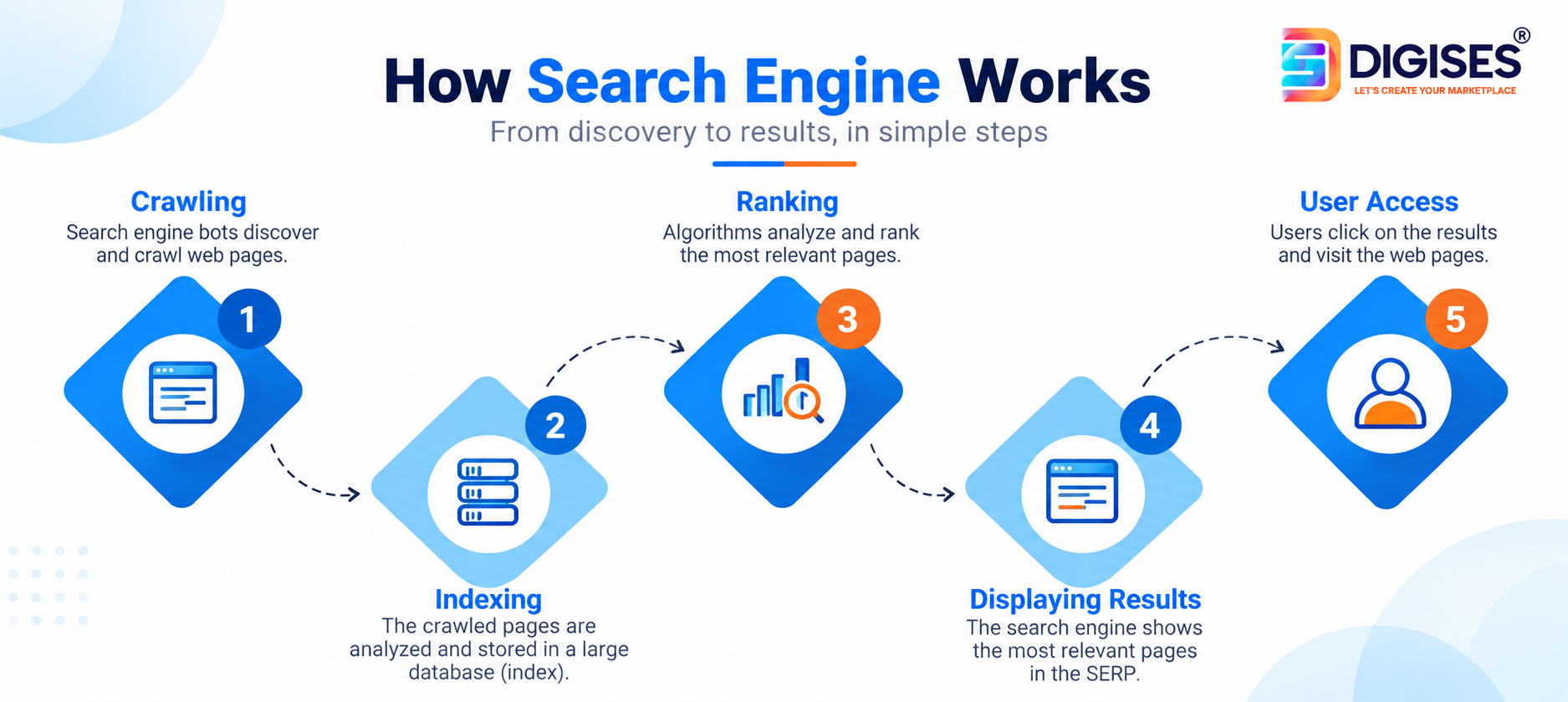
At a simplified level, search engines need to discover, crawl, understand, and index webpages before those pages can potentially appear for relevant searches.
SEO supports this process through:
Being indexed does not guarantee a high ranking. Search visibility depends on relevance, usefulness, competition, and many other factors.
SEO is commonly divided into several areas:
These areas overlap and should generally work together.
On-page SEO focuses on elements within individual webpages.
This can include:
The objective is to make the subject of a page clear and useful to visitors.
Technical SEO focuses on helping search engines access, crawl, understand, and index website content.
Important areas can include:
Technical SEO creates a foundation for other SEO activities, but technical optimization cannot compensate for poor or unhelpful content.
llms.txt should not be presented as a required Google SEO technique.
Google's current guidance states that llms.txt is not needed for Google Search and does not positively or negatively affect Google Search visibility or rankings.
Therefore, it should not be treated as a Google ranking requirement.
Content SEO focuses on creating useful information that satisfies the needs of a particular audience.
Useful formats can include:
The objective should not be to create a separate page for every keyword variation.
Instead, each page should have a clear purpose and provide meaningful value.
Original research, practical examples, first-hand observations, expert analysis, and useful data can make content more valuable than simply rewriting information already available elsewhere.
Search intent is the reason behind a user's search.
Understanding intent helps determine what type of content should be created.
The user wants to learn.
Examples:
The user is researching options before making a decision.
Examples:
The user is closer to taking an action.
Examples:
The user is looking for a particular website, company, or destination.
A successful SEO strategy aligns content with the user's actual intent instead of forcing every keyword onto the same page.
Keyword research is the process of identifying words and phrases people use when searching.
It can help identify:
However, keyword research should be used to understand users rather than simply generate phrases to insert into content.
A useful framework is:
Keyword → Search Intent → User Need → Topic → Helpful Content
Local SEO focuses on helping businesses become discoverable for relevant searches connected to a geographical area.
It can involve:
For Chennai businesses, search behaviour may vary by neighbourhood, language, and the way users phrase their searches.
Users may search in English, Tamil, or Tamil written using English characters.
Businesses should understand their actual audience rather than creating large numbers of nearly identical location pages solely to target additional keywords.
Off-page SEO refers to activities and signals outside a website that may contribute to its reputation and authority.
Examples include:
Quality and relevance are more important than simply collecting large numbers of links.
Buying links or participating in manipulative link schemes can violate Google's spam policies.
A sustainable approach focuses on earning recognition through useful content, genuine relationships, and valuable information.
E-E-A-T stands for:
E-E-A-T is not one individual Google ranking factor. It is a useful framework for considering whether content demonstrates qualities that make it reliable and valuable.
Experience refers to relevant first-hand knowledge.
It can be demonstrated through:
Expertise involves demonstrating relevant knowledge and competence through accurate explanations, professional experience, qualifications, original research, reliable references, and practical methodology.
Authority can develop through consistent subject expertise, original research, industry recognition, professional experience, and reputable references or mentions.
Trust can be supported through:
The goal is to help readers understand who created the information, why they are qualified, and whether the information can be trusted.
AEO stands for Answer Engine Optimization.
The term generally refers to creating and structuring content so that important questions are answered clearly in answer-oriented search experiences.
For example:
SEO is the process of improving a website so that search engines can understand its content and users can discover relevant information through organic search.
The answer can then be expanded with examples and supporting information.
AEO-oriented content can use:
The objective is not to make every answer artificially short. It is to make information clear, accurate, complete, and useful.
GEO stands for Generative Engine Optimization.
The term is commonly used to describe approaches for creating information that can be understood and potentially referenced within generative AI search experiences.
Modern search can provide answers that combine information from multiple sources.
Useful GEO-oriented content can include:
There is no guaranteed technique that ensures a webpage will appear in an AI-generated answer or receive an AI citation.
The stronger strategy is to create original, accurate, useful information that deserves to be referenced.
These concepts overlap rather than functioning as completely separate optimization systems.
| Area | Main Purpose |
|---|---|
| SEO | Improve discoverability and understanding in search |
| AEO | Make questions and answers clear |
| GEO | Create useful information for generative search |
| E-E-A-T | Demonstrate experience, expertise, authority and trust |
A well-researched article can use SEO fundamentals, answer user questions clearly, provide original information for generative search, and demonstrate genuine expertise.
The objective should not be to create separate content for every acronym.
Create one genuinely useful resource that serves the audience first.
Search is evolving with AI-powered experiences such as Google's AI Overviews and AI Mode.
These experiences can provide answers that synthesize information from multiple sources.
However, AI search does not make traditional SEO fundamentals obsolete.
Useful content still needs to be:
Businesses should avoid claims such as “guaranteed AI citation” or “guaranteed AI ranking.”
No legitimate SEO technique can guarantee that a particular AI system will select a specific webpage as a source.
AI-assisted content is not automatically excluded from Google Search.
The important consideration is the quality and purpose of the resulting content.
Creating large quantities of pages primarily to manipulate search rankings, particularly when those pages lack meaningful original value, can create problems under Google's spam policies.
AI can assist with:
Published content should still be reviewed for accuracy, originality, relevance, factual support, first-hand experience, expert interpretation, and user usefulness.
AI should support the content process rather than replace genuine knowledge and editorial responsibility.
Businesses should avoid:
Repeating keywords unnaturally throughout a page.
Publishing pages with little useful information simply to target more keywords.
Rewriting existing content without adding meaningful original value.
Creating large quantities of pages primarily for search visibility.
Acquiring links primarily to influence rankings.
Creating content that does not answer what users actually want.
Failing to review important information when facts change.
Treating rankings as the final objective instead of measuring meaningful business outcomes.
Useful SEO metrics can include:
The appropriate metrics depend on the business.
An ecommerce website may focus on organic revenue, while a local service business may focus on qualified enquiries and phone calls.
Rankings can be useful indicators, but they should not be treated as the only measure of success.
SEO is the process of improving a website so that search engines can understand its content and users can discover relevant information through organic search.
SEO can help businesses become discoverable when people search for relevant products, services, information, or solutions. It can support organic visibility, relevant traffic, enquiries, sales, and long-term search presence.
The main areas commonly discussed are technical SEO, on-page SEO, content SEO, off-page SEO, and local SEO.
No. Keywords help identify how people search, but effective SEO also involves search intent, content quality, technical accessibility, website structure, internal linking, credibility, and user needs.
AEO, or Answer Engine Optimization, generally refers to structuring information so that questions can be answered clearly in answer-oriented search experiences.
GEO, or Generative Engine Optimization, generally refers to creating useful, original, well-structured information that can be understood within generative AI search experiences.
E-E-A-T should not be described as one specific ranking factor. It is a framework for evaluating experience, expertise, authoritativeness, and trustworthiness.
No. Google's current guidance states that llms.txt is not needed for Google Search and does not positively or negatively affect Google Search visibility or rankings.
AI-assisted content can appear in search, but content produced at scale primarily to manipulate rankings and lacking meaningful value can violate Google's spam policies.
Neither is universally better. SEO focuses on organic visibility and generally takes time to develop, while Google Ads provides paid visibility while campaigns are active. Businesses may use either or both depending on their objectives.
There is no fixed timeline. Competition, website condition, content quality, authority, search demand, and implementation quality can all influence results.
SEO is more than ranking a webpage for a keyword.
It is about making useful information easier for people to discover while helping search engines understand what a website and its pages are about.
A modern SEO strategy brings together:
Search Intent + Helpful Content + Technical SEO + Website Structure + Experience + Expertise + Authority + Trust
As search evolves, AEO and GEO provide useful ways to understand answer-oriented and generative search experiences. However, they do not replace the fundamental principles of creating useful, accurate, accessible, and trustworthy content.
Digises is a leading digital marketing and web development agency helping startups, SMEs, and businesses grow online. Our team shares practical insights on SEO, Google Ads, social media marketing.
No: 775/1, T H Road, New Washermenpet,
Chennai - 600081
Digises is a performance-based digital marketing company in Chennai with 50+ successful brands, helping businesses generate qualified leads, improve visibility, and achieve measurable growth.